WATERWAYs 2005
Welcome to the blog for WATERWAYs 2005, an eco-vention art exhibition taking place Friday June 10th-Saturday June 11th at the Santa Elena Port in Venice, coinciding with La Biennale. This blog will record the progress and reactions of the event. In the spirit of this collective art happening, your contributions to the WATERWAYs 2005 blog will be essential, so please, throw in your 2-cents or more. You can comment or become a member to compose your own postings by emailing the blog master, Angel.
Friday, October 21, 2005
Friday, October 14, 2005
Thursday, October 13, 2005
Two Continents and Beyond: Waterways Istanbul
Two Continents and Beyond: Waterways
Lead Curators & Producers: Renée Vara and Asli Sumer
Curatorial Advisors: Ethan Cohen, Paul Middendorf and Mary Mattingly
Artists: Nicole Amore, Theo Angell, Art Hijack, John Breiner, Donna Clovis, Orly Cogan, Aaron Day, Christoph Draeger, David Eckard, Tamar Hirschl, Ryan Jeffery, Erin Letterman, Michelle Livsey, Miranda Lloyd, Eva Mantell, Mary Mattingly, Jason Middlebrook, Zhu Ming, Naoto Nakagawa, Lindsey Nobel, Dina Noto, Agata Oleksiak, Rune Olsen, Jim Peters, Paige Saez, Avelino Sala, Lisa Schilling, Dana Shea, Raphaele Shirley, Shinique Smith, Stephanie Snyder, Amy Steel, Vicky Tomayko, Lauren Was, Jeannie Weissglass and Bernard Williams
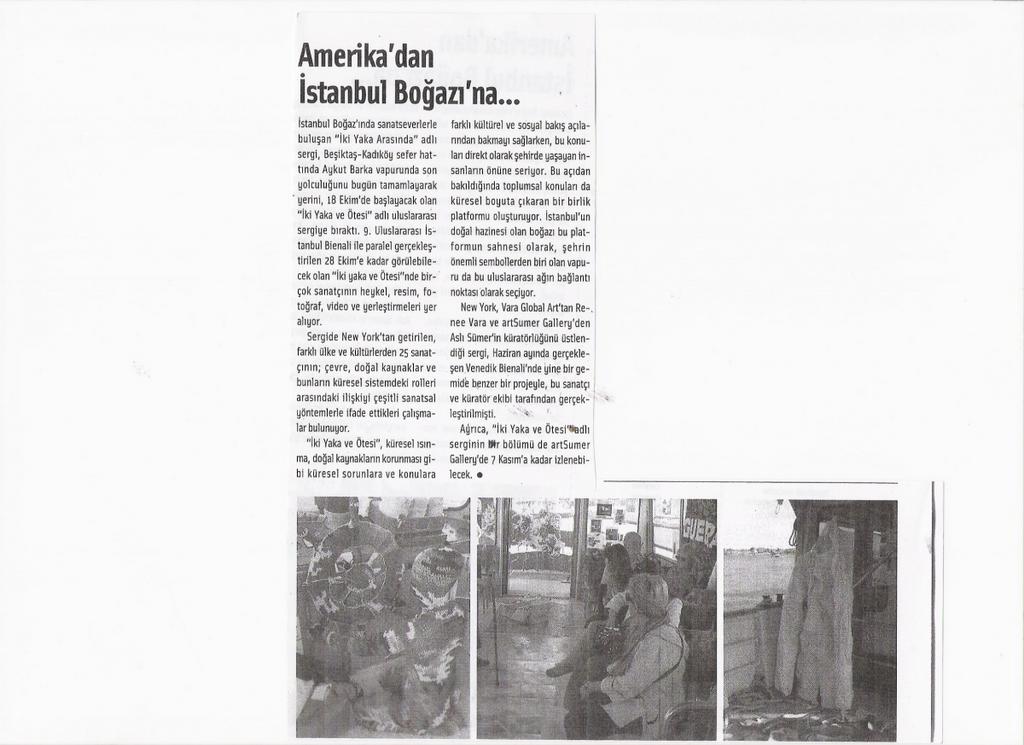
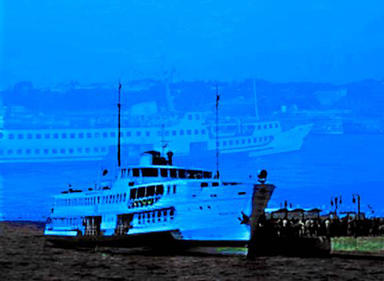
Two Continents and Beyond: Waterways, led by Renée Vara and Asli Sumer, is the second statement in a series of interventions. Recontextualized around the specific concerns of Turkey, the show repeats guerilla practices on the Bosphorus and investigates the iconic role of the Vapur (the local public ferries) as the nexus of the politics surrounding trade, commerce and environmental resources.
Waterways: what began as a collective happening during the 2005 Venice Biennale now returns as an Official Independent Project of the 9th Istanbul Biennale. This collaborative group of over 30 artists and 7 curators initiated a critical dialogue regarding the relationship between the environment, natural resources and its role in systems of transportation.
The show, installed on one of Istanbul’s largest vapurs, the Aykut Barka, will sail between the historic ports of Besiktas on the European coast and Uskudar on the Asian. The ride provides a conscious pause to actively engage and explore the complex dynamic inherent in the systems of politics and international exchange as it relates to environmental conservation and global warming.
This collaboration of artists and curators represent a collective commentary on such issues and wrestles with the utopian ideal embodied in closed systems and international exchanges of divergent viewpoints.
Press & Opening Reception: October 18th, 6PM at Kabatash Port
Opening VIP and Press Party: October 18th @ 9PM
artSumer Gallery
1.cadde No:62 Arnavutkoy 34345 Istanbul
Tel : 90-212-263-5623, www.artsumer.com
RSVP: rsvp@varaart.com
Further information and press images:
Renée Vara, T (001-921-1708), info@varaart.com
Asli Sumer, T (001-90-212-263-5623), info@artsumer.com
Further information regarding Waterways collective:
http://www.varaart.com/main.asp?page=waterways and www.waterways2005.blogspot.com
This project was realized in cooperation with Istanbul Metropolitan Municipality and I.D.O.
Tuesday, August 09, 2005
Tuesday, August 02, 2005
Friday, July 29, 2005
Why Camouflage?
It’s about behavior, human behavior, which often “masks” the truth or the reality through the ever-changing lens of action and movement. Each dancer will exaggerate their everyday movements: walking, drinking, and interacting through the space of a hotel atmosphere, during the opening day of the fair. This artistic and dance strategy is intended to make the way humans utilize their everyday movements – both physical and gestural – visible. Its also intended to make both the viewer as well as the performer conscious of their movements and interactions. The Camouflage sculptures serve as a metaphor for how humans use and abuse their daily behaviors to construct a notion of reality and to control their perception of “self”. Humans use their behavior as a construction to manipulate perception – and as we know, perception in our contemporary society is reality. But like camouflage, perception shifts, and has not anchor or stability – it visibility is constantly changing and moving.
Artist Statements
Art Hijack
Elana Rubinfeld
Rick Haatj travels the globe looking for great art. And great art, in its own masterful ways, travels to Rick Haatj. From the holdings of a little known yacht, to the Richelieu Wing of the Louvre, to the canals of
Somewhere in
Avelino Sala
"La Espera project is the metaphorical answer to many questions which appear in everyday life for all of us.
Who is not waiting for something fantastic? Who is not dreaming with complete happiness?
The surfer is waiting for the wave, a wave that is never arriving, but that doesn’t matter, he keeps on waiting, is he a hero or an idiot?"
Aviva Rahmani
We settle around water then foul it. When artists address water, we are speaking from our hearts to the heart of our world, that depends on water. Our global water ills are a body that has "trigger points", as in acupuncture. These trigger points, the most degraded urban areas in our landscape, once restored, could provide healing for much larger areas. Art is healing because it is passionate. Passion is a trigger, cleaning what has been fouled.
Bradon Ballengée
"Love Motel for Insects"
While exploring the rainforests of
Within moments hundreds of flying visitors came to the piece- fluttering moths, blood-
sucking Hemipteras, clunky beetles, delicate caddisflies, ants, lacewings, and many more- the diversity of colors, shapes and sizes was fantastic! Female moths released chemical pheromones to attract mates and consequently “painted” the piece, beetles hungrily lumped one upon the other while releasing vibrant colored eggs and primordial
fluids- a kind of arthropod rite of Bacchus and abstract expressionism. On the second night, spiders and their predacious kin began to visit. They laboriously decorated the sculpture with their own form of geometric abstraction. Attracted to movement, other predators such as tarantulas, mantids, scorpions, bats, and amphibians began nightly visits. I counted, photographed, recorded predator/prey relationships, and attempted to identify each species that interacted with the sculptures. Fascinated and inspired by this initial experience, I began creating these temporary black-light works at varied ecosystems around the world. To date I have photographed arthropods in Asia, Central America, Europe, and
Dana Shea
The Waterways Project
Mural
The mural I created for the WATERWAYS PROJECT is in part derived from the canals in
Digital Images
This project for me brings about issues of our natural control systems rain/snow and to what extent in our contemporary society do we control water to heat or freeze or in other parts the world to keep our houses warm or cool. Our society’s efforts to re-use and treat contaminated water. Our society’s efforts to control water seem like a recent occurrence but in actuality- it can be placed back as far as our first villages and now corporations.
Emmanuelle Gauthier
To refer to the theme of Waterways, on environmental issues, I gave a lot of thought to which of my photographs will best address these concerns.
I choose 2 photographs that I took of TV news coverage in 2003 during the first American invasion of
Eva Mantell
I know I just can't get past myself to get to anything, anyone or any place.
G-Local - a project of the Group of 77.
What is the correlation between production and destruction? Culture is changing nature and nature is changing culture.
We are building a body of knowledge, a cultural map, a physical guide that is relevant to the present and continually evolving. Our machine, G-Local, measures the effects and byproducts of production on indigenous matter, vernacular customs and exchanges. Here, we use the city of
The comprehensive use of the G-Local is to measure the (de) evolution or (non) progress of a place, since environment and culture are linked inexorably. It has two sets of sensors: Cultural (measuring the ephemeral fluidity of the exchange of ideas) and environmental (measuring concrete evidence of physical change). Its primary sensors read person-to-person exchanges in the form of eye contact, dilation, stance, blood flow, stride, odor, and conversation as well as synthetic-to-nature exchanges including noise levels, water composition, chemical and organic emissions, gases, and ultraviolet radiation.
The theory of the 77 global cultural index is manifested in the Reader's ability to create maps through specific poetic and algorithmic readings captured in diverse communities through sampling and recording. The result can be found locally in the participation and awareness of the Reader, or it can be found globally and quantified in the near future at
Jeannie Weissglass
Water lust... water warm and basic... water transforming and spiritual. Water is almost always at the root of my work as a source of inspiration. I think the idea of gathering the art and showing it on the boat where it can travel and be seen surrounded by water is quirky, appropriate, and pretty great.
John Breiner
Decay, progression, my work interacts and revolves around life. My surfaces, although man made, are rescued from life—and they show it. Whether discarded on the street, out the trash or just found, I search out objects that show the path of their travels. Stained by Water, dirt or light, these objects provide the curious with the insight into their past life and provide me with a point to make my connection. I observe life’s marks and add my own, providing evidence of another stop in the object’s travels. I create the work with the idea of being viewed as artifacts, to give my take on things in addition to life’s impact on it. The pieces created are some times commentary, documentations or warnings but the goal is to reach people and make these once discarded and ignored objects valued possessions again. Hopefully in the process it will cause people to slow down a bit and understand that there is value in all that surrounds them.
Lisa Schilling
My work is a blending of my two interests: materiality - the language of objects and materials - and phenomenology. I have found that both focuses, however disparate, can be served through the exploration of the planet, its elements and its varied systems. By recasting what I observe out of human-made materials, I am better able to understand and appreciate the deep beauty and power of the natural world, and, ultimately, my relationship to it.
Waterways presents a unique opportunity for me to put my work into an arena wherein both the specific discussions about art and the larger dialogues of global issues will be availed simultaneously. I am very excited to be a part of the Waterways project because its creators are intent on making a space for serious art practices and personal ethics to coexist. By re-humanizing the corporate art fair experience, Waterways offers by example a way for all participants to reenter into their own relationship with society and the world at large.
Mary Mattingly
Waterways is a collaborative organization directly in line with my own concerns. In my artwork, I think it is important to predict future conditions through what is happening today, with the environment as well as within relationships, as these relationships become contained within a reified and mediated space. I create weareable homes for a resulted nomadic condition, and make sculptural installations that meld the real and fake in environment. I then photograph these spaces to be documents of what our world could become. The work focus’s on the human condition and the conditioning of humans within a globalized world.
One of my main concerns is the future of water. As we begin to commodify and privatize this natural resource, many things happen. In most cases it becomes cleaner and healthier. However, simultaneously, water becomes unaffordable for many people. I will show two sculptures in Waterways. They are both necessary for living in the future. One sculpture is a model made from ordinary recycled materials. The plans for this sculpture will allow many people the ability and ease to drink cleaner water where once they could not afford it (in Bolivia, for example, 20% of a family’s income is put towards clean water even now after their local privatization scandal) through the reuse of everyday materials. The second sculpture is a floatable, wearable home. One can be nomadic, traverse land and sea, essentially remaining protected and not needing much more. Both of these sculptures will be necessary as a pair; although water levels will rise and we will lose land, we will gain salt water and be in constant battle for drinkable fresh water.
Michelle Vara
Writing an artist statement to me is more difficult that actually producing art.
I see the world through pictures and objects.
My statements all visual & emotional are evoked by many means.
The mediums I choose are paint, drawing and metal sculpture.
I do and want to do nothing more than produce art.
My income is from visual objects that I produce. Some times designed around a client, world, Issues, emotions a space or a use.
If you as the viewer have an emotional reaction (good, bad indifferent) to my work I have achieved my goal.
I am an artist always collecting and organizing visual information for review by the world.
My work is my existence.
That is why the waterways gave me the perfect opportunity to speak out on pollution and the miss- use of our natural resources.
Miranda Lloyd
Hybrid ecosystems, familiar yet unidentifiable landscapes, and ant farms of mutant botany collide in a world of visceral beauty. Spanning sculpture, photography, and etchings,
Naoto Nakagawa
LIFE, LOSS, DEATH, REBIRTH
My subject has always been nature. Nature's beauty, and rage, and fragility. I am always trying to paint nature in a new way, to create a completely different kind of landscape painting.
The format of this work is a historical slide presentation, from the original marshes to the glory of
Nina Teglio
The human or animal body hides organic and anatomical imperfections, and an unconscious narrative/descriptive force that allows continuous transformations, and the assumption of different forms.
In many of my photographic and video works I have used images of animals and bodies, to explore the complexity of the body as an organic entity, and as a metaphor of emotional human feelings; but not yet as a social entity. This is first time though, that I have used real animals and that I have chosen the installation as language and as a modality of direct communication with the audience.
The idea of working with both the environment as the boat and the concept of the Waterways (allowing another interpretation of the term "environment" as related to natural resources), revealed to be very stimulating in relation to my work practice, but also very difficult to deal with. Being the Vaporetto a public space, it easily tends to become dispersive. This difficulty drew me towards the necessity of having a direct contact with the audience, and therefore to develop an installation work that utilizes the concept of Choice. - Through the way that people respond to such a "small thing" as the life of a fish, we can take a sample of how they behave in relation to bigger issues on the environment.
The audience can interact with the installation by deciding the fate of the fish, which are placed in various spots of the Vaporetto, inside plastic water bags. They have the freedom to choose if either freeing the fish in the Venetian Lagoon, or keeping them in "captivity" and letting them die.
As a consequence, and in both cases, the existence of the installation completely depends from the decision/interaction of the audience.
Orly Cogan
The flag, hand stitched embroidery on Italian print fabric, evokes a historical reference while intermingling contemporary context and concept with the lost art of embroidery. It is a narrative – waiting for the safe return of an old ship, wearied after a long and treacherous journey. The woman, canonical figures, are the ephemeral mascots, forecasting the destiny of the voyage.
While on the one hand exploring common feminine archetypes, my work also aims to represent the fusing of old and new as we see in
Raphaele Shirley
I have been interested, in my work over the last 10 years, in what I would call “circumstantial collisions”, moments where multiple situations come to meet and cross, yielding sometimes very unusual results. These ensue from the fusion and convergence of unlikelihoods, the outcome or moment of inter-occurrence becoming the art: a semi psychedelic, loose sociological, physical and/or urban experiment.
In these projects, planned with people, events and objects, sometimes in the public, sometimes in more classical venues such as museums or interior spaces, momentum picks-up as their realization progresses, diversities merge, generating a powerful supercharge of energy.
Waterways contained much of this circumstantial potential and power of convergence, borne through hope and generosity but also through the willingness to take great risks, to put oneself out there - “in the cold” or “in the wet” so to speak- without too much care for institutional rescue, rafts or guarantees of smooth cocktail sippings. Relying mainly on its own sense of orientation, Waterways with Renee Vara & Company- heroically set out “in the uncertain” and “in the hope”, to
I had the honor, as a participant, to affect the course of this marvelous event. Bumping into fellow French mischief-makers in one Bellini clad palace we dared extract a large group of Gallic palazzo-goers to our improbable floating experiment. Deep in the 1am night we danced and deleriumed into some remote waters, cruise-embarkation- military-zone of the
The project now belongs to those who stood on the boat or watched it pass by, as much as to those who instigated it in the first place. Its ecology is based on the all-encompassing, on something that takes IT all in and then reprocesses the IT for positive and regenerative forces and outcome. This is the true future of any ecological endeavor and Waterways, in its realization was a living example of what can be done with openness, faith and strength of vision. When stray parts converge with constructed projections, and those divergences are led to meet, magic occurs!
Rune Olsen
"In our culture, the decisive political conflict, which governs every other conflict, is that between the animality and the humanity of man. That is to say, in its origin Western politics is also biopolitics." Giorgio Agamben, The Open, Man and Animal, p 80
I want to contribute to the incredible exciting project, Waterways (2005) because it is vital we spotlight and contextualize the effects of the current sociopolitical ideologies on our planet’s diversity. Presenting the project on a boat is such a perfect venue—beyond the obvious Noah's ark reference—it is a political vessel carrying goods and ideas, reflecting on the water as a source to sustain life currently being unsustainably exploited. My life-size animal sculptures examining the interplay among desire, power structures and society. They are all made from what I refer to as "social materials." These are environmentally friendly and recycled materials readily available, such as newspaper and tape.
For Waterways (2005) I have chosen to contribute "Rattus Novegicus" (2004) a sculpture that explore the problematic relationship between ethics and capitalism. "Rattus Novegicus" (2004) was made in response to the investment policies of The Norwegian Oil Fund, a more than a 100 billion dollar mutual fund through which
For the portfolio box cover I have made the drawing "Holy Killer Whales" (2005), representing two killer whales mating. Both ferocious and endangered, the two killer whales represent the problem of sustainable diversity and elevating nature into an icon. Once chosen as an icon, like many animals we like, are they not representing human beliefs rather than their own natural dynamic? Though this might be a paradox hard to avoid, I believe it is important to continue questioning our perception of nature.
Tamar Hirschl
My artwork, while mainly political, aims to ultimately connect people, I am concerned about the effect that global water systems have on the environment, and would like to call attention to the availability of new methods for the treatment and reuse of water to conserve available resources. I am especially interested in how this relates to agriculture and architecture, since we are constantly modifying the landscape around us for human use, disturbing the wild animal habitats previously extant in that environment. Projects like construction projects for irrigation, ditches, tunnels and walls in cities. These projects prevent all the wildlife that had previously inhabited the construction sites from being able to reach their nests, and changed the balance of nature for miles around the sites. I hope that my participation in Waterways will draw attention to the disturbances that both peacetime commerce and wartime conflict create in our environment.
Tuesday, June 21, 2005
Thursday, June 09, 2005
11.06 3:00-Dawn on the Vaporetto

The project explores the role of the curator as some one who can no longer be considered “objective” in their view, gaze and observation of art. Acknowledging that “performance” always retains an element of subjectivity, the curator takes on the role of social anthropologist to transform the cabin of the Vaporetto into a shelter for displaced people.
As those who frequently attend international art events know, art handlers, artists, assistants, and young art cognoscenti often find themselves without housing due to their social and economic conditions of attendance. Therefore, this performance aims to look at the social constructions of displacement as it affects societies of both humans and other species. The social constructions of international art exhibitions inform a politics of who is invited and included and who is not. Such constructions formulate a similar pattern in our society with respect to species preservation—it is often politics and social constructions which determine what species are worthy enough to received protection and preservation.
The events, happenings and developments during the sleepover—who attends, who stays and what occurs—will be recorded in “field study” style, wherein basic events and attendances will be recorded. This will allow meaning to develop rather than be constructed or controlled by the artists or the curator. Accordingly, this performance suggests that there is little difference between an “event” and “art performance” in the contemporary moment, and it is often only social circumstances and constructions which elevate it to the heights of “art.”

Tuesday, June 07, 2005
Eva Mantell's Top Ten Favorite Artworks About Water
Since we're on the subject of water, I thought i'd send in my top ten
list of favorite artworks about water, starting in the bathtub, going
out to the open sea and ending up on the kitchen counter:
10) Jacques-Louis David, The Death of Marat
9) Frida Kahlo, What Water Gave Me
8) Suzanne Valadon, Drawings of her son after the bath
7) Gericault, Raft of the Medusa
6) Minoan mosaics/frescoes of dolphins
5) Minoan Jars with Painted Octopus
4) Henri Matisse, Goldfish
3) Andy Goldsworthy's icicles
2) David Hammons' snowballs
1) Harold Edgerton, photo, Milk Drop Coronet
Friday, June 03, 2005
Virtually, a forest of links
I have just returned from Miranda Lloyd's studio.
Thursday, June 02, 2005
The Beginning
For me, the seed of this project began in Miami with the "Lifeboat". Paul Middendorf, a curator from Portland OR, and I went to Miami in December during Art Basel, snuck our way into the Positions (the Basel galleries containers turned into exhibition-spaces), and used the space to build a boat. We organized artists - over 60 artists worldwide sent work to us that had to do with the environment, trade/borders, utopian concepts, and micronations.
In Miami, we met and engaged in a dialogue with many people, from beachgoers who were curious about the work, to refugees who shared stories of their personal experiences with us, as well as people attending the art fairs.
At one point we met and discussed with Renee Vara, a curator who runs varaart.com, about some of our many convening ideas. We came to learn quickly that we both felt that we wanted to do whatever we could to provide a platform for socially conscious art, that would activate communities with new ideas, take chances, be subversive, and grow as an alternative, a long-tail to the mainstream.
Renee became increasingly interested in doing something in Venice because of the current conditions there with rising tides (that are literally proof of global warming), and causing the entire city to sink. As she and I learned more about each other, we came together with the following concerns - our own government’s overriding ignorant position on the environment; global warming and its ramifications, as well as many other current issues surrounding water, like privatization in less-powerful countries and pollution from industry. More to come…
Wednesday, June 01, 2005
Schedule of Events
1 PM - Vaporetto opens to the public
4 PM - 6 PM - Performance: Avelino Sala, "La Espera"
10 PM - 12 Midnight - Opening Reception and
Performance: Agata Olesiak, "Camouflage"
3 AM - Dawn - Overnight Sleepover: Renée N. Vara, "Castaways"
Curators and Artists of WATERWAYs 2005
CURATORIAL COMMITTEE: Renée N. Vara, A. Faculty, NYU & Solomon Guggenheim Museum Lecturer; Eugenia Cherkasskaya, Vara Global Fine Arts; Ethan Cohen, Ethan Cohen Fine Arts; Mary Mattingly; Karen LaGatta; Irene Nikolai, independent curator.
ARTISTS: Art Hijack, Elena Bajo, Brandon Ballengée, John Breiner, Orly Cogan, Christoph Draeger, Peter Fend, Emmanuelle Gauthier, G-77, Jason Hackenwerth, Tamar Hirschl, Susanne Kriemann, Michelle Vara Livsey, Pan Xing Lei, Eva Mantell, Elahe Massumi, Mary Mattingly, Jason Middlebrook, Zhu Ming, Naoto Nakagawa, Agata Oleksiak, Rune Olsen, Libia Perez & Olafur Ami Olafsson, Jim Peters & Vicky Tomayko, Aviva Rahmani, Avelino Sala, Lisa Marie Schilling, Dana Shea, Raphaele Shirley, Nina Teglio, Jeannie Weissglass, Wu Shan Zhuan, and Inga Svala Thorsdottir.
Press Release and Portfolio Info
Check out the WATERWAYs 2005 Press Release.
Want to make a monetary contribution to this project? Here is how you can turn "green" into green consciousness. You can own a unique porfolio made by exhibited artists exclusively for the support WATERWAYs.
What is WATERWAYs?
WATERWAYs -- Art as Action
June 10th, 12AM - June 11th, 6PM
Location: St. Elena Port
Curatorial Proposal
Waterways is a collective effort, action, ecovention and exhibition created and self-produced by 5 curators and 33 international artists to be installed on a public Vaporetto. The exhibition will take place alongside the Venice Biennale, at St. Elena, for the opening weekend - June 10th and June 11th.
The Waterways project organically developed amongst a group of artists and curators, who wanted to create socially conscious art and reassert a utopian role for art as an international communicator, which could shape, inform and transform the dialogue regarding specific global issues. The genesis of the project started with Renee Vara and Mary Mattingly, as an intentional response to the present "fair factor" dominating the presentation and exhibition of art. It has since grown into an international forum of academics in the arts and sciences, curators, artists, private patrons, art institutions, interested volunteers, and the general public. They have gathered public and private resources, skills, abilities, voices and efforts to construct and create a global call for attention and international cooperation regarding the preservation of our world's natural resources. Much like Joseph Beuys 7000 Oaks, which began at Documenta II, the project attempts to begin a series of self-produced interventions, which deal with environmental issues in a nonpolitical context.
Waterways is as much about the process as it is about the exhibition. The exhibition and the installation of 33 original works of art that deal with rising tides, species preservation, global warming and air pollution, suggests that there are multiple models in the display and exhibition of art, which do and can offer alternative means to voice aesthetic responses. More important, the locus of "meaning" of such exhibitions is not just bound by the material art objects that are installed, but are situated in the process, the collection and the organization of a "community" from disparate and unaffiliated individuals and institutions, which become connected through a shared value system.
Waterways has been completely self-produced, self-funded, and self-organized. It represents a "call" to people in both the art world and other communities, of how social activism and collective efforts can create "affects", "dialogues," "activities" and "communities" which are as informative to the construction of culture as material production is in our society. Its aim is in the processes of inclusion and pluralism, rather than the current dominant functions in the art world. The organizers of Waterways make no differentiation between a social demonstration and an art intervention, as they aim to maintain a vibrant expression for public art within our society.
Renee N. Vara, Curator
New York, NY
renee@varaart.com